The “Vogelkop Superb Bird-of-Paradise”
This bird can dance for hours, all just to get the attention of one female. To find a partner, the black-and-blue feathered males perform a goofy dance and slide around the females with their feathers puffed out into a black, oval-shaped fan, painted with bright blue feathers. The selection of a mate is wide, considering that females pick among 15-20 males! You’ll find t
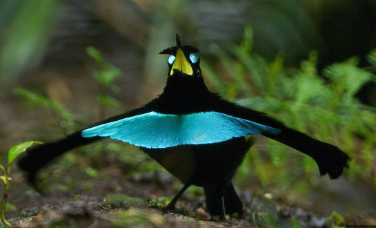
hese colorful little guys in the dense, rocky rainforests of Indonesia (southeastern Asia), particularly the western region of New Guinea. They forage along the leafy undergrowth of the forest floor in search of a feast of insects, which consist of spiders and larvae, and fruit. Said in quite the ridiculous name–the Vogelkop lophorina (another name for this species) is part of the Birds-of-Paradise, a group of 44 different species of birds found in the rainforests of eastern Australia, the Moluccas, and, of course, New Guinea. They are separated into this category for their vibrant feather patterns and captivating courtship dances.
Here’s a short YouTube video of a male performing his dance…Link
The “Secretarybird”
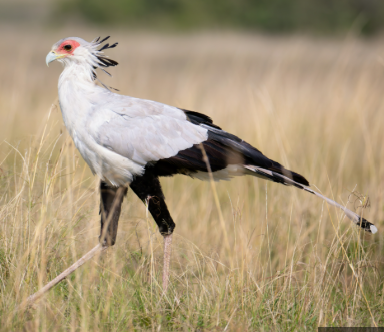
Snakes of the African Safari fear this bird. If this 4-foot-tall bird comes into contact with a snake, it will aggressively stomp it to death, then swallow it whole. The Secretarybird is said to have gotten its name from Europeans, who worked as secretaries and wore short black pants to their knees and gray tailcoats. This bird walks up to 20 miles while hunting for reptiles, small mammals, and snakes. When prey is spotted, they chase it with their wings spread out and their feathered crest raised high above their head. They are not solo hunters, typically in pairs or families. While the Secretarybird is a ground hunter and most famous for trampling snakes, they are also the tallest raptor in the world, and can fly with a wingspan of 7 feet! Though if you ever see one, they’ll likely be stalking the tall grasses on foot.
Here’s a YouTube video of a Secretarybird killing a snake, along with some more facts…Link
The “Arctic Tern”
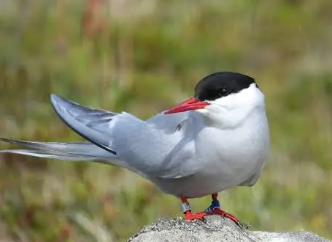
If cross-country flying were a sport, these birds would prevail in every race. Living in the cold climate of the Arctic, the Arctic Tern is naturally a summer hunter. They migrate from the Arctic to the Antarctic in late summer, flying 25,000–50,000 miles every year just to experience two summers! All this mileage eventually adds up to one Arctic Tern flying the distance of 1.8 million miles a lifetime, the equivalent of 4 trips to the moon and back! How do they navigate this huge distance? It is said that this bird uses magnetoreception–an ability to recognize Earth’s magnetic field–and the stars throughout the night, and the sun in the day to travel the Earth. Because of all of this flying, the Arctic Tern hunts by plunge-diving into the ocean and the sea’s waters to catch a fish, though they are actually not very strong swimmers, so they only stay in the water for a short time, catching a fish and then quickly continuing on the migration. These birds are very territorial and tend to attack humans, though they are also very social and fly in large flocks. They live 15-30 years, and prefer to nest on islands with chilly air.
Here’s a YouTube video showing an Arctic Tern flying in many different areas…Link
The “Northern Shrike”
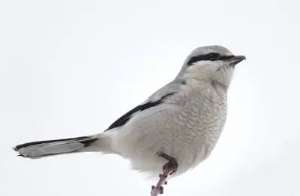 Impaling your prey on thorns, barbed wire, and branches gives you every reason to have the nickname “Butcher Bird.” The Northern Shrike or Butcher Bird is a Songbird, but they act like a raptor. Due to not having sharp, long talons like raptors do, they make up for this by impaling their dead prey on sharp objects. This substitutes for talons because it makes the prey easier to tear and rip up, and it even stores the food for later if the bird isn’t hungry enough for it then. They are completely carnivorous, eating other songbirds, fledglings, spiders, small mammals, and lizards. The Northern Shrike also likes to hunt like a Kestrel. When prey is seen, they fly to speedily trail after it and capture it with their bill or feet. If the prey is bigger, such as a songbird, they dive into the ground to finish it off. You can find this aggressive songbird in the Taiga, Alaska, Siberia, and Canada.
Here’s a YouTube video of a Northern Shrike with its prey…Link
The “Kestrel”
This bird can see ultraviolet (UV) light, which we use to tan. Useful vision, like a Kestrel’s, makes it easier for the falcon to find food. They use this trait to track urine trails, which appear very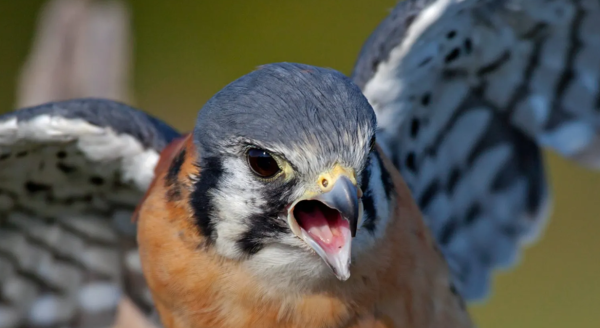 bright to them. Being able to spot ultraviolet rays is not the only cool thing about the Kestrel; they can also perform hover-hunting, which means remaining stationary in the air, just like a hummingbird! They eat large insects, small birds, and small mammals like voles, shrews, and mice. At times, they can also consume lizards, snakes, frogs, toads, spiders, and scorpions. This bird is quite beautiful, with multicolored feathers of blues, reds, and yellows, making it the most colorful falcon. As a defense mechanism, they have two black spots on the back of their head to make it seem to predators as if they are facing forward. The Kestrel is actually the smallest falcon in North America, roughly the size of a Blue Jay. They are found around North America, in places like Alaska and Canada, but you can also find different kinds of Kestrels in South Africa!
bright to them. Being able to spot ultraviolet rays is not the only cool thing about the Kestrel; they can also perform hover-hunting, which means remaining stationary in the air, just like a hummingbird! They eat large insects, small birds, and small mammals like voles, shrews, and mice. At times, they can also consume lizards, snakes, frogs, toads, spiders, and scorpions. This bird is quite beautiful, with multicolored feathers of blues, reds, and yellows, making it the most colorful falcon. As a defense mechanism, they have two black spots on the back of their head to make it seem to predators as if they are facing forward. The Kestrel is actually the smallest falcon in North America, roughly the size of a Blue Jay. They are found around North America, in places like Alaska and Canada, but you can also find different kinds of Kestrels in South Africa!Here’s a YouTube video of a Kestrel hovering in very slow motion…Link